The Hendrix performance Steve Vai says is impossible to copy
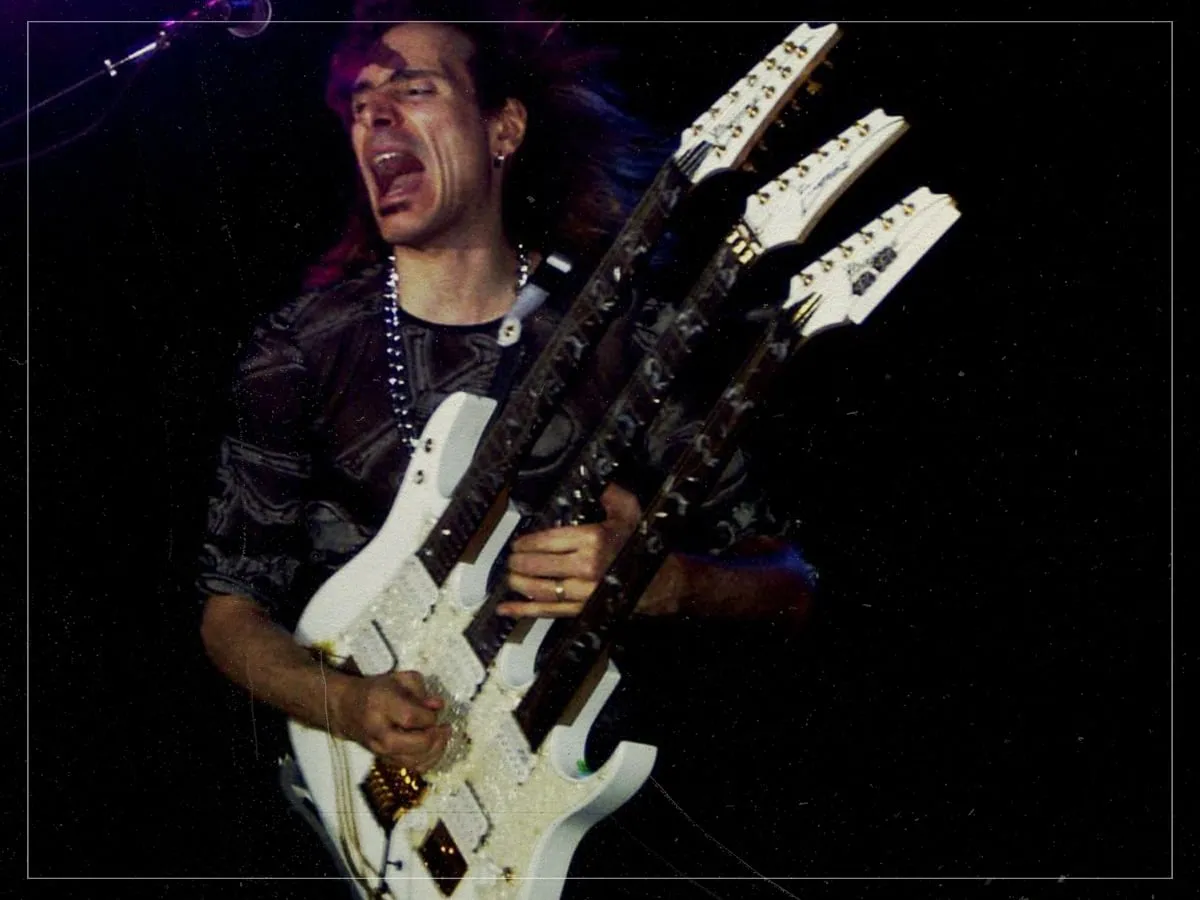
The path to legendary guitar mastery isn’t always a straight line. For some musicians, it begins not with formal lessons, but with a series of bizarre, demanding tests designed to push the limits of what is technically possible. This is the story of how Steve Vai entered the orbit of musical legend, and the profound artistic philosophy he developed by witnessing some of rock’s most extraordinary expressions.
The introduction to this world came through a chance audition. When Frank Zappa was seeking a guitarist, the young Steve Vai, still relatively unknown and nervous, stepped forward. The audition was far from conventional; it was less a musical test and more a mental marathon. Vai had to navigate increasingly esoteric challenges set by Zappa—shifting rhythms, adding impossible notes, and grappling with sonic concepts that felt physically unattainable. It was a masterclass in endurance, forcing the young guitarist to find solutions in realms that felt, at times, physically impossible.
Yet, Vai possessed the innate skill to impress. He absorbed the chaotic demands, not just by brute force, but by demonstrating a willingness to sit with the seemingly impossible until it made sense. This aptitude was built upon a rigorous foundation; Vai had already spent time transcribing Zappa’s complex music, effectively learning to dissect the language of guitar solos and rhythmic passages, transforming bewildering sounds into notation.
This intensive apprenticeship allowed Vai to navigate Zappa’s musical machinery with ease. He learned that true mastery involves patience—the ability to sit with complex ideas until they unfold. It was this process of deep immersion that honed his technical ability and prepared him for the next great comparison in his musical life.
Having established his own formidable skill set, Vai’s perspective on guitar divinity shifted. He found himself drawn to the transcendent power of Jimi Hendrix, a figure whose playing remains an untouchable benchmark for soaring expression and pure emotional delivery. For Vai, Hendrix represented a level of musical freedom that transcended mere technique.
Vai observed that Hendrix did not simply play notes; he manifested his entire psyche through the instrument. As Vai noted, there is no separation between the guitarist and the guitar—the energy, the soul, and the physical presence merge into a single, unbreakably expressive voice. Hendrix was, in essence, channeling a pure creative impulse, lassoing notes from the ether.
This connection was most powerfully demonstrated in legendary performances. Hendrix’s live shows, such as the performance of “Machine Gun” with The Band of Gypsy’s live at the Fillmore, showcased an artistry so complete that every note seemed imbued with an otherworldly connection. Vai found that this level of creative flow—this unmovable state of inspired contemplation—was something truly unique.
While countless virtuosos exist today, Vai concluded that Hendrix remains unmatched when it comes to this soaring, soulful expression. The genius of Hendrix lay not just in technical facility, but in the ability to combine flawless execution with an inimitable character that draws the masses in. He proved that the most profound guitar playing is not just about what you can play, but about what you can feel and project.
Buy on Amazon
Credit
