Dylan vs Seeger at the Newport Folk Festival 1965
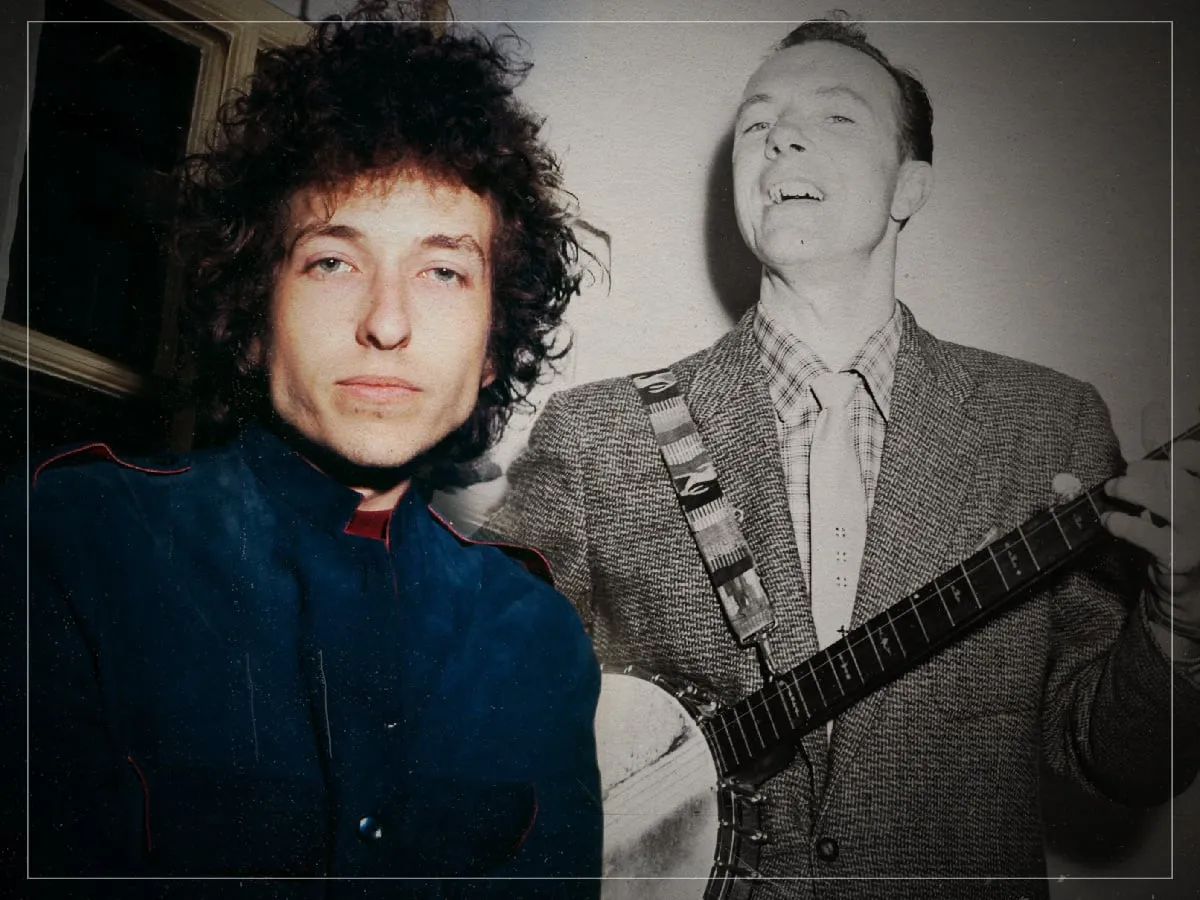
In the annals of counterculture history, few figures capture the rebellious spirit of the 1960s quite like Bob Dylan. Yet, the moment that truly redefined his legacy—and ignited a massive cultural debate—was not just a song, but a performance: his landmark set at the 1965 Newport Folk Festival, the very moment he “went electric.”
Prior to this seismic shift, Dylan walked the path of traditional folk heroes like Woody Guthrie and Pete Seeger. The folk community, devoted to the purity of acoustic sound and historical fidelity, welcomed him into their fold. True folk music, after all, demands a devotion to the acoustic instrument, making the electric guitar an unwelcome intruder.
But as the decade progressed, Dylan began absorbing the sonic revolution brewing in rock and roll and electric blues. His move toward amplification was a natural evolution, culminating in works like Bringing It All Back Home, which embraced this exciting new sound. This transition, however, left his established folk devotees divided.
Newport in 1965 was meant to be the epicentre of this tension. Dylan had built a dedicated audience there in the preceding years, but the atmosphere upon his return was anything but welcoming. This year, Dylan made a bold, defining choice: splitting his performance into two distinct sets—one acoustic, one electric.
The resulting spectacle was incredibly controversial. Listeners heard boos and jeers, echoes of the divided reactions he had witnessed throughout his career. In Manchester, for instance, one audience member famously branded him ‘Judas’.
Among those present was Pete Seeger, a close friend and mentor who had guided Dylan during his early years in New York. The sheer shock of Dylan turning electric created a firestorm of myth surrounding the event. Stories quickly circulated, including the dramatic legend that Seeger, enraged by the distorted sound, attempted to destroy the sound cables with an axe.
This dramatic tale became immortalized in biographies, but the reality was far less dramatic. Decades later, Seeger revealed the truth: I wasn’t against Bob going electric. I was furious that the sound was so distorted you could not understand a word that he was singing.
When asked what truly caused the friction, Seeger admitted that the issue was not the instrument itself, but the poor sound quality. He insisted that the goal was clarity, and when the sound obscured the music, his frustration boiled over. The legend of the enraged mentor seeking to cut the cables was a dramatic exaggeration, born from the hot-headed emotions of a revolutionary moment, but the core truth remains: for many folk purists, the sound quality was the real enemy of the electric revolution.
Buy on Amazon
Credit